


Close Menu
    Facebook X (Twitter) Instagram
    Facebook X (Twitter) Instagram
    Subscribe
    • Home
    • Top Stories
    • Business
    • Tech
    • Companies
    • Events
    • Announcements
    Home»Technology»Improving DNA-Detecting Transistors
    Technology

    Improving DNA-Detecting Transistors

    Marie JonesBy Marie JonesFebruary 26, 2017Updated:February 26, 2017No Comments2 Mins Read
    Share
    Facebook Twitter LinkedIn Pinterest Email

    Tsukuba, Japan — Researchers in India and Japan have developed an improved method for using graphene-based transistors to detect disease-causing genes.

    Graphene field-effect transistors (GFETs) can detect harmful genes through DNA hybridization, which occurs when a ‘probe DNA’ combines, or hybridizes, with its complementary ‘target DNA.’ Electrical conduction changes in the transistor when hybridization occurs.

    Nobutaka Hanagata of Japan’s National Institute for Materials Science and colleagues improved the sensors by attaching the probe DNA to the transistor through a drying process. This eliminated the need for a costly and time-consuming addition of ‘linker’ nucleotide sequences, which have been commonly used to attach probes to transistors.
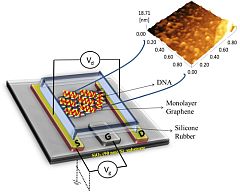
    Thumb_STAM170224The research team designed GFETs that consist of titanium-gold electrodes on graphene – a one-atom-thick layer of carbon – deposited on a silicon substrate. Then they deposited the DNA probe, in a saline solution, onto the GFET and left it to dry.

    They found that this drying process led to direct immobilization of the probe DNA on the graphene surface without a need for linkers. The target DNA, also in saline solution, was then added to the transistor and incubated for four hours for hybridization to occur.

    The GFET operated successfully using this preparation method. A change in electrical conduction was detected when the probe and target combined, signaling the presence of a harmful target gene. Conduction did not change when other non-complementary DNA was applied.

    DNA hybridization is usually detected by labelling the target with a fluorescent dye, which shines brightly when it combines with its probe. But this method involves a complicated labelling procedure and needs an expensive laser scanner to detect fluorescence intensity. GFETs could become a cheaper, easier to operate, and more sensitive alternative for detecting genetic diseases.

    “Further development of this GFET device could be explored with enhanced performance for future biosensor applications, particularly in the detection of genetic diseases,” conclude the researchers in their study published in the journal Science and Technology of Advanced Materials. – BusinessNewsAsia.com


    Health Japan science Technology Transistor
    Share. Facebook Twitter Pinterest LinkedIn Tumblr Telegram Email
    Previous ArticleBPO Firms Remain Philippines’ Top Employer
    Next Article Stock Trading Operations of Evergrande Life Restricted

    Related Posts

    OpenWorld (NASDAQ: OPNW) Signs Term Sheet to Finance and Operate a Solar-Powered AI Computing Network Built on Tesla Powerwall Batteries

    October 14, 2026

    GP Energy Tech, a subsidiary of Gold Peak, showcases Nickel-Zinc battery technology at Hong Kong Electronics Fair

    October 14, 2026

    Duiba Group Founder Gifts 11.21% Stake to Employee Incentive Platform in Record-High Founders-to-ESOP Transfer by Share of Capital in Hong Kong Market History

    September 21, 2026
    Add A Comment

    Comments are closed.

    Latest News

    • Chervon Names Krystle Adams Director of Sales Recruiting
    • Chervon Names Terry Lucero Director of National Accounts – Industrial
    • Chervon Names Devin Murray Director of Sales – Northern Division
    • GMG Appoints Nine-Time Motocross World Champion Antonio Cairoli as Brand Ambassador and Invites Visitors to EICMA 2026
    • Tenstorrent Announces a $1.5B Series E at a $6.2B Valuation
    • JCB and Krungsriayudhya Card Launch the Krungsri JCB Ultimate Credit Card
    • OpenWorld (NASDAQ: OPNW) Signs Definitive Merger Agreement to Acquire Blocksight
    • Scalare Launches EquityRoom, Adding a Subscription Revenue Stream to Its Founder Ecosystem
    • Megaannum Capital and Zhongke Xianxing Venture Capital Enter into Strategic Partnership
    • Cotecna Group Acquires Energon Labs, Strengthening Global Pharmaceutical Testing Capabilities and Expanding its Presence in India
    © 2026 BusinessNewsAsia.com
    • About Us
    • Contact Us
    • BusinessNews.ph
    • AsiaPEVC.com
    • DevFiNews.com
    • RenewableEnergy.ph

    Type above and press Enter to search. Press Esc to cancel.