

- An international collaboration is developing coating materials that could make windows better insulators.
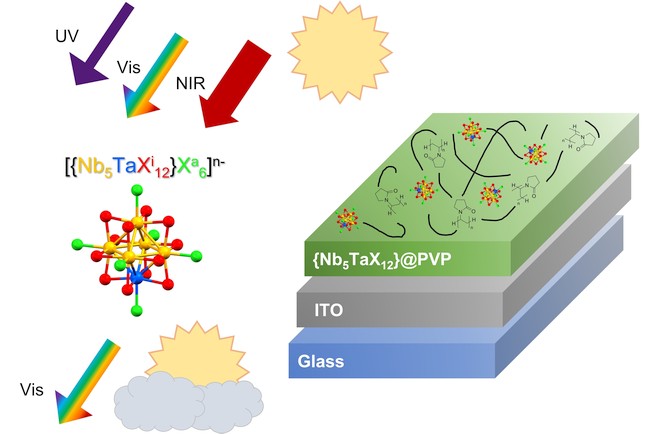
A French-Japanese research collaboration has fabricated metal nanocomposite coatings that improve the insulating properties of window glasses. The new coating prevents a significant portion of near-infrared (NIR) and ultraviolet rays (UV) from passing through, while at the same time admitting visible light. The findings were reported in the journal Science and Technology of Advanced Materials.
“Although the fabrication of a commercial products is still a long way ahead, our work demonstrated a significant improvement in UV and NIR blocking properties compared to previous research,” says solid-state chemist Fabien Grasset, research director at the French National Centre for Scientific Research (CNRS).
“Buildings account for a large part of global energy consumption,” explains Grasset, “with a large amount of the annual energy consumption of a standard building going to cooling and/or heating systems to maintain indoor temperatures at comfortable levels.” Scientists are looking for ways to develop window glass coatings that can block the entry of NIR radiation so that buildings, and even cars, can consume less energy to keep it cool inside. However, this needs to be done in a way that still allows visible light to enter. Ideally, harmful UV rays would also be blocked.
To this end, the international French-Japanese research collaboration fabricated and analysed the performance of nanocomposites based on niobium-tantalum cluster compounds containing chloride or bromide ions.
They found that chloride-based nanoclusters provided the best performance in terms of blocking NIR and UV rays and allowing the passage of visible light. NIR and UV blocking by the nanoclusters depended on their concentration, dispersion and oxidation state. By tuning these parameters, the team was able to improve the nanocluster performance.
The nanoclusters were dispersed into a polyvinylpyrrolidone (PVP) matrix that was then coated onto indium-tin-oxide (ITO) glass. The combination increased the transmittance of visible light while reducing that of NIR and UV rays, relative to previous research. “These are very promising coating materials that block the most troublesome NIR wavelengths,” says Grasset.
“We have a long history of Japanese-French collaboration,” he continues. “We were already convinced that we are stronger working together by mixing our different cultures and ways of thinking. The international LINK project has reinforced this belief. We will continue to do our best to make further progress towards finding solutions for the global warming problem.”
Further information
Fabien Grasset
French National Centre for Scientific Research (CNRS)
Email: fabien.grasset@cnrs.fr
Research paper: https://www.tandfonline.com/doi/full/10.1080/14686996.2022.2105659
About Science and Technology of Advanced Materials (STAM)
Open access journal STAM publishes outstanding research articles across all aspects of materials science, including functional and structural materials, theoretical analyses, and properties of materials. https://www.tandfonline.com/STAM
For more information on STAM, contact
Dr. Mikiko Tanifuji
STAM Publishing Director
Email: TANIFUJI.Mikiko@nims.go.jp
Press release distributed by Asia Research News for Science and Technology of Advanced Materials.