

Mixing two or three alkyl-π liquids can achieve the right combination of functions for soft electronics.
Soft electronics are an exciting and innovative class of technology that brings together bendable, stretchable semiconducting materials for applications in areas ranging from fashion to healthcare. Researchers have recently developed a new technique to adjust the properties of liquids that could be used to create soft electronics.
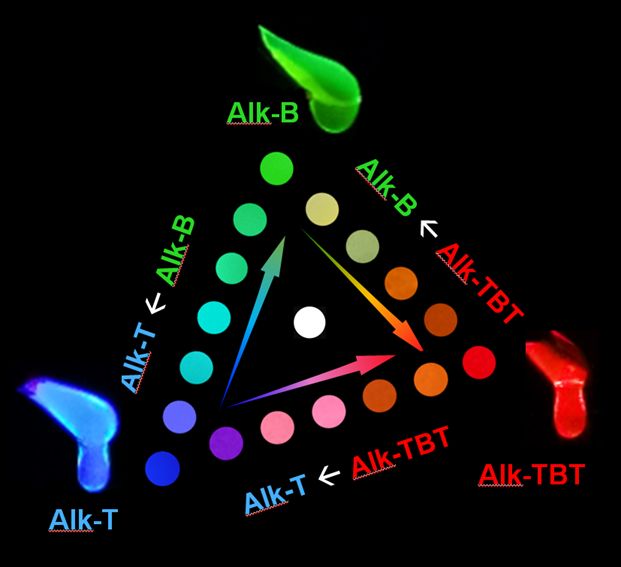
Researchers successfully blended various combinations and proportions of three solvent-free alkyl-π room-temperature liquids that fluoresced red, green, or blue light, with no color variation within the material showing that the alkyl-π liquids had merged evenly. Credit: Image is reproducible by CC-BY license. Please credit the STAM Journal.
Room-temperature alkylated-π molecular liquids (known as alkyl-π liquids) are an exciting new material that holds great promise for soft electronics. However, one challenge with these fascinating liquids lies in fine-tuning their physical, chemical, and electronic properties – including their ability to interact with light – to achieve the desired functionality.
A new study, led by researchers from the National Institute of Materials Science (NIMS) in Tsukuba, Japan, has explored a strategy for blending together alkyl-π liquids to merge their functions homogeneously. The researchers used photoluminescent color tuning to demonstrate how well the process has worked. Their findings have been published in the journal Science and Technology of Advanced Materials.
Previous efforts to control the properties of alkyl-π liquids have taken one of two approaches. The first involves incorporating small amounts of other molecules, such as dyes, into the liquid. “When modulating function by adding solid dopants, the dopant molecules have poor solubility, leading to insoluble aggregates and inconsistencies in properties such as luminescent color,” says Dr. Takashi Nakanishi of the Research Center for Materials Nanoarchitectonics at NIMS.
The second approach involves chemically modifying the alkyl-π liquids. While this can achieve a uniform result, designing and synthesising entirely new molecules is difficult and less time- and cost-effective.
In the new study, researchers synthesised three solvent-free alkyl-π room-temperature liquids that fluoresced red, green, or blue light, and then they blended the liquids together in varying proportions. They successfully created a range of homogeneous liquid blends of colors with no color variation within the material, showing that the alkyl-π liquids had merged evenly.
The team also assessed how well the two liquids had mixed by changing the temperature and studying how the flow of the mixed liquids changed over time at different temperatures. This approach further confirmed that the liquids were successfully blended together.
“The liquid–liquid blending method implemented in this study for alkyl-π liquids facilitates the production of low-volatility, ink-like materials that exhibit a diverse spectrum of uniform luminescent colors, devoid of any color unevenness,” Dr. Nakanishi says. “This means it will be possible to apply or coat the desired function with simple operations such as painting, sandwiching, or soaking the liquid materials wherever needed.”
The research opens the path to blending alkyl-π liquids to vary other functions, such as photoconductivity, charge retention, or gas sensing.
Further information
Takashi Nakanishi
National Institute for Materials Science (NIMS)
nakanishi.takashi@nims.go.jp
Paper: https://doi.org/10.1080/14686996.2025.2515007
About Science and Technology of Advanced Materials (STAM)
Open access journal STAM publishes outstanding research articles across all aspects of materials science, including functional and structural materials, theoretical analyses, and properties of materials. https://www.tandfonline.com/STAM
Dr. Kazuya Saito
STAM Publishing Director
Email: SAITO.Kazuya@nims.go.jp
Press release distributed by Asia Research News for Science and Technology of Advanced Materials.