


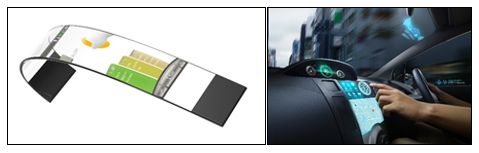
 TOKYO, Apr 13, 2020 – (JCN Newswire) – Showa Denko (“Showa Denko”; TSE: 4004), National Institute of Advanced Industrial Science and Technology (AIST), New Energy and Industrial Technology Development Organization (NEDO) and Research Association of High-Throughput Design and Development for Advanced Functional Materials (ADMAT) have cooperatively proved that introduction of artificial intelligence (AI) into the process to develop flexible transparent film[1] can reduce the numbers of times of experiment to produce film that satisfies required properties to one-twenty-fifth (1/25) or less of those conventional development methods require.
This development work has been subcontracted by NEDO’s “Ultra High-Throughput Design and Prototyping Technology for Ultra Advanced Materials Development Project” (Ultra-Ultra PJ) to the consortium. By fully utilizing AI and multiscale simulation[2], Ultra-Ultra PJ aims to reduce substantially the numbers of times of experiment and development period required for the development of flexible transparent film from those conventional ways of material development require.
Researchers of SDK, AIST and ADMAT have been conducting AI-based searches for polymers that satisfy properties required for designing of flexible transparent film, which is essential for development of mobile devices. As the first step of this research, skilled researchers produced 27 types of films. Then researchers incorporated chemical information including molecular structures and mole ratios into explanatory variables[3] with a special method named Extended Connectivity Circular Fingerprints (ECFP4), and chose converted transmissivity[5], braking stress and stretch as objective variables[6]. These three objective variables have trade-off relations and are incompatible among them. Then, researchers made the AI learn actual values of these variables.
Following these steps, researchers prepared data including comprehensively dispersed explanatory variables, made the AI learn concept of the deviation value[7] and estimate several combinations of materials for films that would maximize the three objective variables with the same ratio. Then researchers manufactured three types of films based on the recommendation AI made. Concurrently, as a comparative experiment, the skilled researchers who prepared the 27 sample films at the first step also made 25 types of films based on their own knowledge and experience. Next, we compared properties of the three types of films based on combination of materials recommended by the AI and 25 types of films prepared by the skilled researchers who made the 27 types of films in the first step of the research.
As a result, physical properties of all of the three types of films made from combinations of raw materials recommended by the AI showed superiority over those of the 25 types of films made by the skilled researchers. We obtained films with physical properties superior to those developed by skilled researchers through one-twenty-fifth times of experiments or less compared to the development process conducted by the skilled researchers. Thus, we proved that we can substantially shorten the period of development of flexible transparent films by utilizing AI, and that it is possible for us to develop films with physical properties superior to those of films made by researches based on their knowledge and experience
Hereafter, we will improve this technology further, and develop a system in which the AI can suggest ratios of combinations of raw materials that can produce target products with even better physical properties while satisfying required characteristics. Today, we also announced the detail of this development work on the Website reporting results of the Ultra High-Throughput Design and Prototyping Technology for Ultra Advanced Materials Development Project (Ultra-Ultra PJ).
Notes:
[1] Flexible transparent film: This is a bendable transparent film. Flexible transparent film is applicable to wide-ranging use such as electroconductive transparent base for touch panel, base for flexible electronic circuit and base for flexible display panel.
[2] Multiscale simulation: This simulation connects material density, flux density and energy density in an interactive way and as common languages. It simulates behavior of various matters ranging from atoms and molecules in micro fields to fluids and continuums in macro fields. For detail, please access the following URLs.
URL: https://www.admat.or.jp/technology
URL: https://tinyurl.com/ujkkndy
[3] Explanatory variables: These are variables that lead to estimates, including mole ratio and kind of functional group of raw materials to make polymers
[4] Extended Connectivity Circular Fingerprints (ECFP): This is a way to describe characteristics of molecules by quantifying kinds and numbers of partial structures including functional groups. For detail, please refer to the following theses.
- Rogers, M. Hahn, J. Chem. Inf. Model. 50, 742 (2010).
- Minami, et al., MRS Advances, 3(49), 2975 (2018)
URL: https://bit.ly/3a4leov
[5] Converted transmissivity: In this experiment, researchers converted refractive index measured by skilled researchers into transmissivity.
[6] Objective variables: These are variables to be estimated, such as physical properties of polymers.
[7] Concept of the deviation value: Converted value of variable by setting the mean value as 50 and standard deviation as 10. In this development work, we calculated deviation values by converting the three objective variables (converted transmissivity, braking stress and stretch).
Outline of organizations
Showa Denko K.K. (SDK)
Location: 13-9, Shiba Daimon 1-chome, Minato-ku, Tokyo
Establishment: June 1939
President: Kohei Morikawa
Scope of business: Manufacture and sale of organic/inorganic chemicals, ceramics, electronic materials, aluminum, etc.
URL: https://www.sdk.co.jp/
National Institute of Advanced Industrial Science and Technology (AIST)
Location: 1-3-1, Kasumigaseki, Chiyoda-ku, Tokyo
Establishment: April 2001
President: Kazuhiko Ishimura
Scope of business: Research and development concerning industrial technology
URL: https://www.aist.go.jp/
New Energy and Industrial Technology Development Organization (NEDO)
Location: Muza Kawasaki Central Tower, 1310 Omiya-cho, Saiwai-ku, Kawasaki-city, Kanagawa
Establishment: October 2003
Chairman: Hiroaki Ishizuka
Scope of business: Management of technological development and related matters
URL: https://www.nedo.go.jp/
Research Association of High-Throughput Design and Development for Advanced Functional Materials (ADMAT)
Location: Central 5-1, 1-1-1 Higashi, Tsukuba, Ibaraki (at the premises of AIST Tsukuba Center)
Establishment: July 2016
Chief Director: Kunihiro Koshizuka
Scope of business: R&D work to reduce drastically the number of prototypes and length of time required to develop functional materials
URL: http://www.admat.or.jp/
For further information, contact:
SDK
CSR & Corporate Communication Office
Phone: 81-3-5470-3235
Fax: 81-3-3431-6215
AIST
Media Relations Office, Planning Headquarters
Phone: 81-29-862-6216
Fax: 81-29-862-6212
E-mail: press-ml@aist.go.jp
NEDO
Miyake or Hara
Materials Technology and Nanotechnology Department
Phone: 81-44-520-5220
E-mail: mkyakemsm@nedo.go.jp
ADMAT
Yukito Matsuda
Phone: 81-29-856-3580
Fax: 81-29-856-3582
E-mail: y-matsuda@admat.or.jp