


Researchers use high-brilliance synchrotron radiation to identify the half-metal mix with the highest half-metallic nature.
Half-metals are unique magnetic compounds that have been attracting interest in the developments of mass-storage technologies. Some of the materials in the family of Heusler alloys were predicted to have a half-metallic nature, but their half-metallic electronic structure varies with their composition ratio and atomic ordered structure.
One property, spin polarization, is fundamental to the material’s half-metallic properties. Spin polarization ratio is a physical property that indicates how polarized the number of electrons with spin in the up and down directions is. Because spin polarization is influenced by the elemental composition of the Heusler alloy, it’s important to characterise and optimise the atomic composition of Heusler alloys to achieve the highest spin polarization. But current methods for determining the spin polarization of half-metals are either time-consuming or only provide an indirect measure.
Now, a team of researchers from Japan, led by Professor Yuya Sakuraba of the National Institute for Materials Science in Tsukuba, have developed a method to quickly determine the spin polarization of Heusler alloys, using high-brilliance synchrotron radiation. With this approach, they were able to rapidly identify the ideal composition of elements to achieve the highest spin polarisation. Their findings have been published in the journal Science and Technology of Advanced Materials.
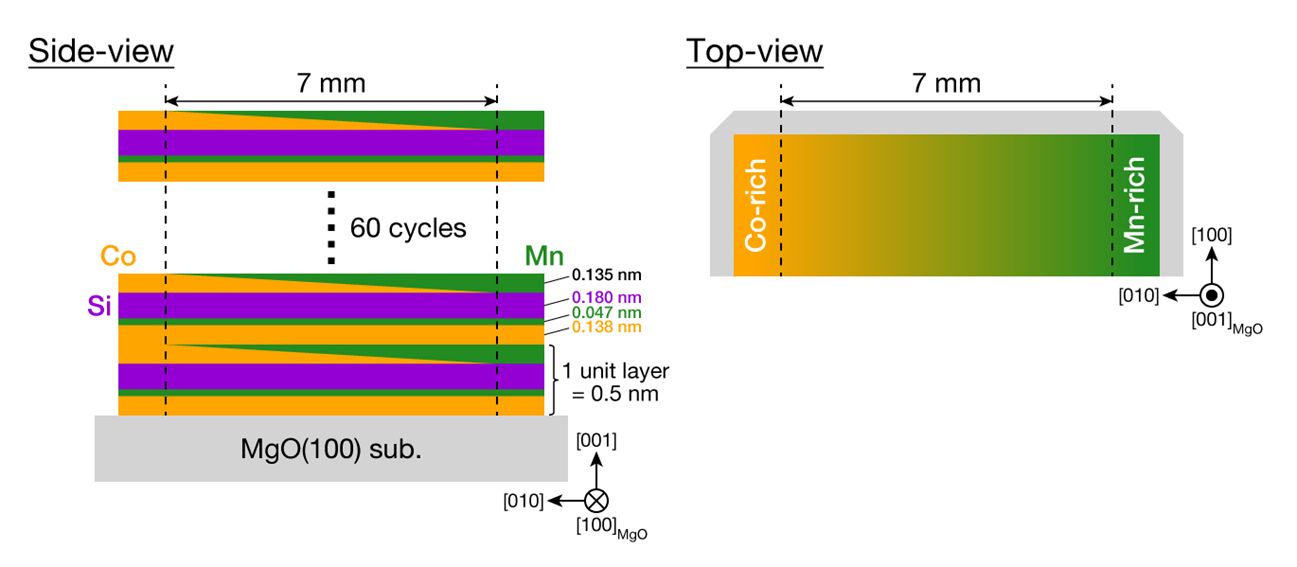
The Heusler alloy in question was a mix of cobalt, manganese and silicon. The research team created composition-spread thin films of the alloy, varying the proportion of manganese from 10 to 40 percent along the length of the sample.
They then bombarded the film with extremely bright radiation at the NanoTerasu synchrotron facility which opened in April 2024. This bombardment revealed that the ideal composition to maximise spin polarization in the alloy was for manganese to make up 27 percent of the alloy’s atomic weight.
This experiment marked the first successful application of photoelectron spectroscopy at NanoTerasu facility. The experiment was done in a single day – much faster than existing methods of determining the spin polarization.
“The findings address a critical challenge in materials science by drastically reducing the time required to evaluate and optimize spin polarization in half-metallic materials,” Professor Sakuraba says.
This study paves the way for wider application of the technique not just to half-metallic materials but a variety of other magnetic and spintronic materials. “The rapid, efficient method presented in this study could significantly impact the development of next-generation technologies, such as high-capacity hard disk drives and advanced spintronic devices,” says Professor Sakuraba.
Further information
Yuya Sakuraba
National Institute for Materials Science (NIMS)
SAKURABA.Yuya@nims.go.jp
Paper: https://doi.org/10.1080/14686996.2024.2439781
About Science and Technology of Advanced Materials (STAM)
Open access journal STAM publishes outstanding research articles across all aspects of materials science, including functional and structural materials, theoretical analyses, and properties of materials. https://www.tandfonline.com/STAM
Dr Yasufumi Nakamichi
STAM Publishing Director
Email: NAKAMICHI.Yasufumi@nims.go.jp
Press release distributed by Asia Research News for Science and Technology of Advanced Materials.