

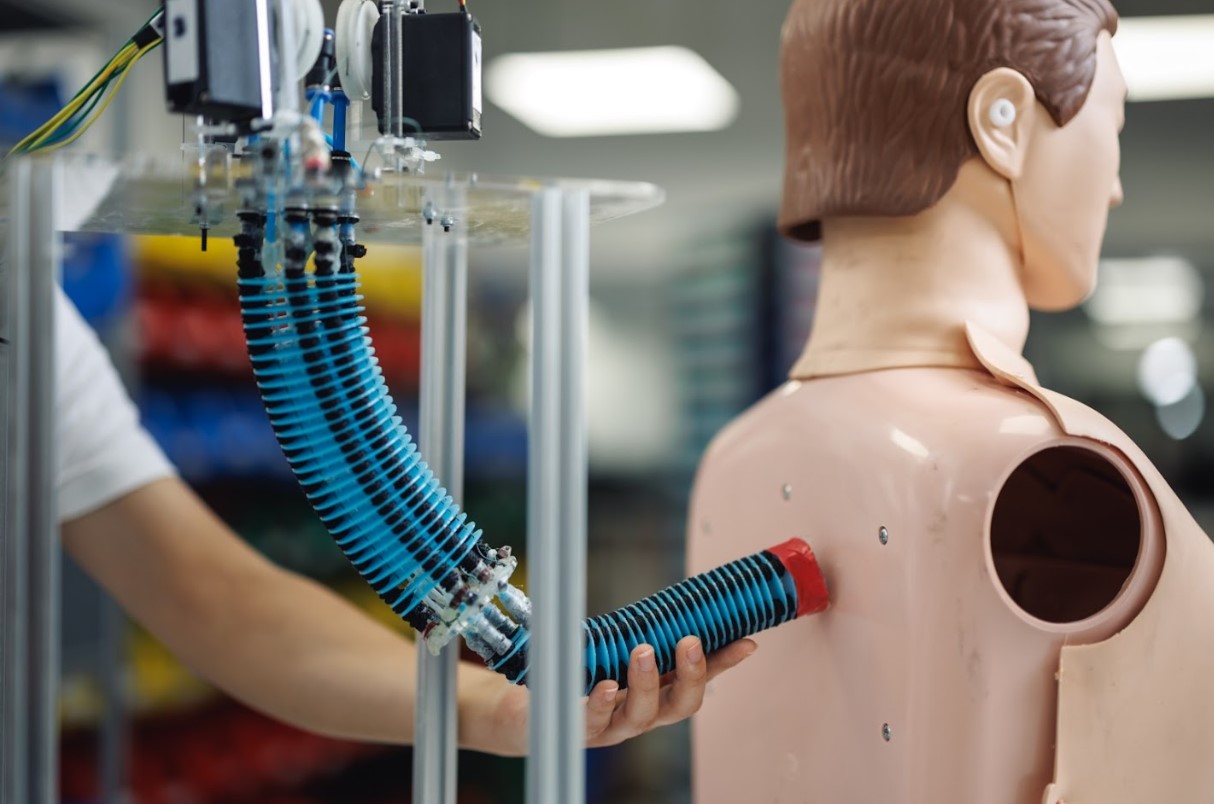

Singapore’s Singapore-MIT Alliance for Research and Technology (SMART) and the National University of Singapore (NUS), working with MIT and Nanyang Technological University, said they have developed an AI control system that lets soft robotic arms learn motions once and adapt in real time without retraining.
Soft robots, typically made from flexible materials such as soft rubber, can be safer for tasks that require compliant contact with people, but their changing shapes make them difficult to control in messy real-world settings where small disturbances like shifting payloads, airflow or hardware faults can disrupt motion.
The researchers said existing approaches have often struggled to combine three capabilities needed for practical use: generalising learned skills across tasks, rapid adaptation when conditions change, and assurances that the robot remains stable and safe while adapting.
In a paper recently published in Science Advances, the team described a controller inspired by how the brain learns, using two sets of “synapses”: “structural synapses” trained offline to provide foundational skills, and “plastic synapses” that update online during operation, with a built-in stability measure to keep behaviour smooth as it adjusts.
“This new AI control system is one of the first general soft-robot controllers that can achieve all three key aspects needed for soft robots to be used in society and various industries,” said Zhiqiang Tang, first and co-corresponding author, now an associate professor at Southeast University in China.
The system was tested on two physical platforms and reduced tracking error by 44–55% under heavy disturbances, achieved over 92% shape accuracy under payload changes, airflow disturbances and actuator failures, and remained stable even when up to half of the actuators failed, the researchers said.
Business News Asia