



Mimicking how the biological world arranges itself could help advance the next generation of nanomaterials.
Tsukuba, Japan – (ACN Newswire) – Collaboration between material scientists, biologists and chemists could advance the development of self-assembling nanomaterials, called nanoarchitectonics, argues a review in the journal Science and Technology of Advanced Materials. And while cyber technologies currently capture the public imagination, investment in this type of collaborative materials research is crucial in order to meet societal needs in energy storage, chemical sensing and a broad range of biological applications.
Nanoarchitectonics allows the arrangement of groups of atoms or molecules into a preordained structure. They can be used to create tiny electrical circuits, manipulate chemicals and create various building blocks for nanoscale technologies. Nanoarchitectonics materials that self-assemble into the desired arrangement are necessary to optimize and advance these technologies.
Katsuhiko Ariga and colleagues in Japan’s National Institute for Materials Science examined recent progress in materials nanoarchitectonics. They believe that predicting the future of these materials requires an examination of biological systems, such as cell and protein surfaces, and macromolecular interfaces.
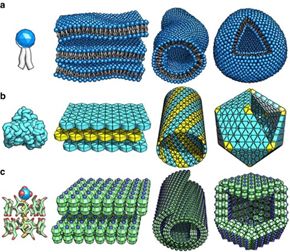
Self-assembled structures are common in biology, for example, in lipid layers or components of cytoskeletons; hence understanding how to control the evolution and behavior of biological structures could help with nanoarchitectonics. Although there is progress in developing some biological interface materials, creating highly sophisticated self-assembled systems is not yet possible. Collaborations between material scientists, biologists and chemists are needed to replicate the characteristics of highly evolved biological systems in nanomaterials.
“The development of functional materials by self-assembly nanoarchitectonics is analogous with the evolution of living creatures from component molecules,” the reviewers write. “However, while living systems took billions of years to evolve, nanoarchitectonics could be used to accomplish many of its anticipated goals within the next few decades.”
For more information, contact:
Katsuhiko Ariga
National Institute for Materials Science
ARIGA.Katsuhiko@nims.go.jp
Read the paper – ‘Self-assembly as a key player for materials nanoarchitectonics’
https://doi.org/10.1080/14686996.2018.1553108
Image: Materials scientists are investigating how to mimic the biological processes that create nanomaterials with desired structures. For example, lipids (a), proteins (b) and sugar-based compounds (c) can self-assemble into an array of shapes and configurations. (Credit: Yang et. al.) https://bit.ly/2TAopNh
Nature Communications volume 8, Article number: 15856 (2017)
https://www.nature.com/articles/ncomms15856/figures/1
About Science and Technology of Advanced Materials (STAM) Journal
Open access journal, STAM publishes outstanding research articles across all aspects of materials science, including functional and structural materials, theoretical analyses, and properties of materials.
For more information about STAM, please contact:
Mikiko Tanifuji
STAM Publishing Director
Tanifuji.Mikiko@nims.go.jp
Press release distributed by ResearchSEA for Science and Technology of Advanced Materials.